
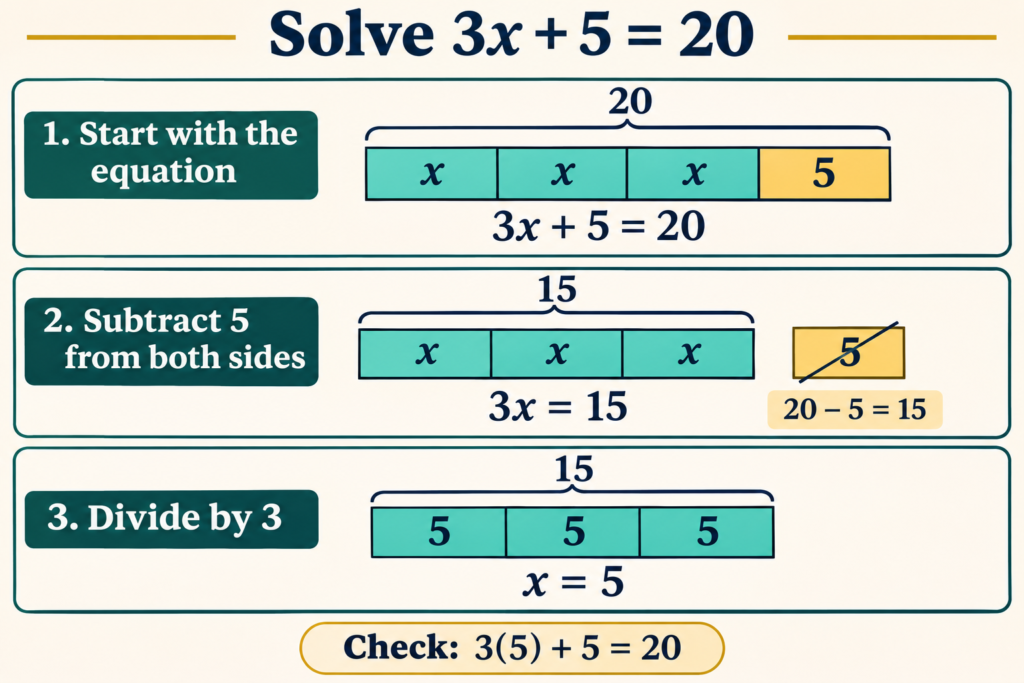
To solve a two-step equation, undo the addition or subtraction first, then undo the multiplication or division. Whatever you do to one side of the equation, do to the other side. Then substitute your answer back into the original equation to check it.
That is the whole method. The rest of this guide shows why it works, using pictures you can sketch yourself, and where students usually go wrong.
What makes an equation a two-step equation?
A two-step equation needs two inverse operations before the variable is alone. The most common forms look like these:
- 3x + 5 = 20 (multiply, then add)
- 2x − 7 = 9 (multiply, then subtract)
- x/4 + 3 = 8 (divide, then add)
If an equation needs only one move, such as x + 6 = 15, it is a one-step equation. For a refresher on that skill, see How to Solve One-Step Equations: 4 Worked Examples. A two-step equation is two of those moves in a row.
Why the order matters
Take 3x + 5. Starting from x, two things happened to it: it was multiplied by 3, and then 5 was added. To get back to x, reverse those steps in the opposite order: subtract 5 first, then divide by 3. Think of taking off your shoes and socks. You put on socks first and shoes second, so you remove the shoes first.
Two visual ways to see the steps
The bar model
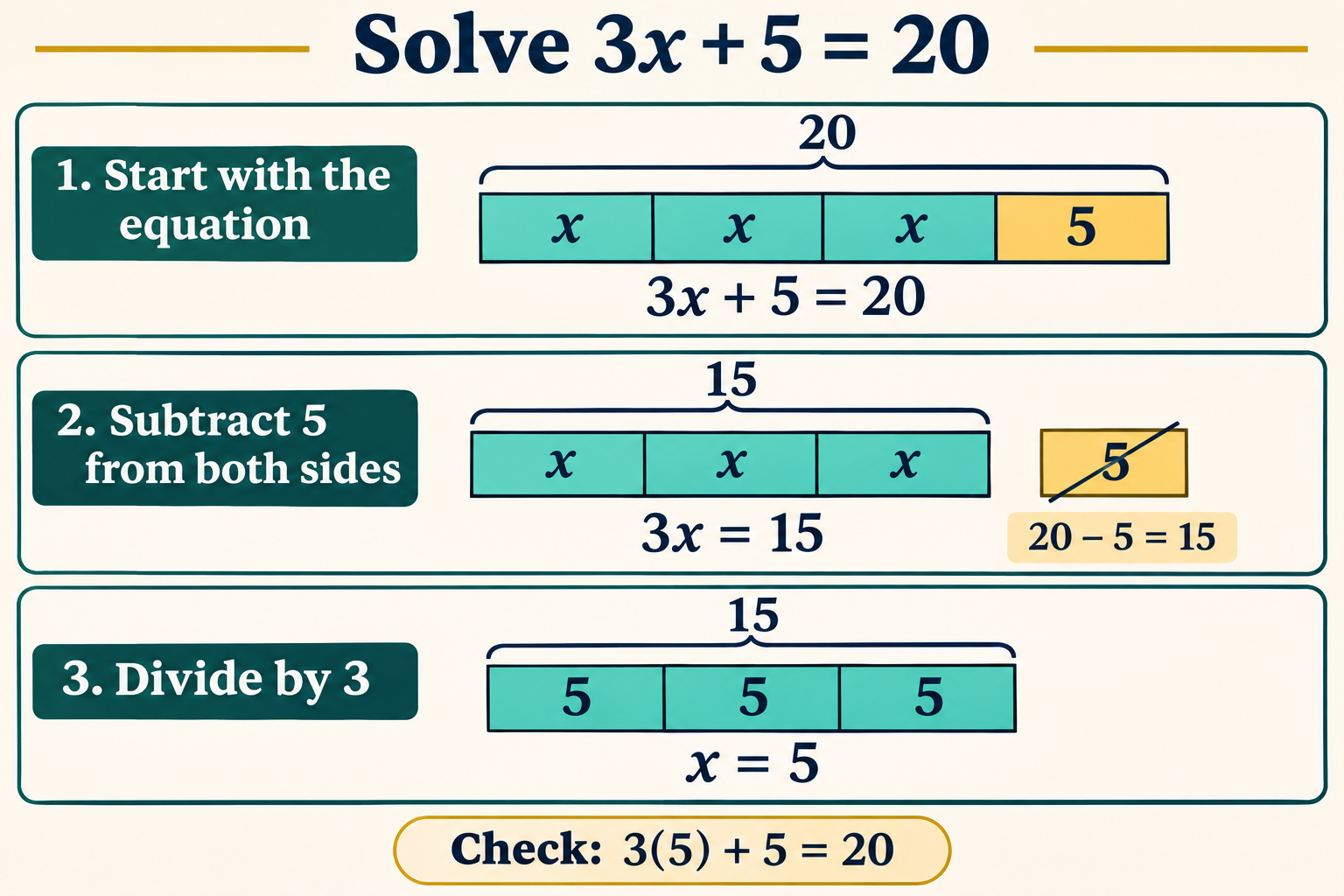
Draw a box for each part of the equation. For 3x + 5 = 20, three boxes hold x and one box holds 5. Together they make 20.
[ x ][ x ][ x ][ 5 ] = 20
Remove the 5 from the total, and 15 is left for the three x boxes:
[ x ][ x ][ x ] = 15
Split 15 into three equal boxes and each x is 5. The picture gives the same moves as the algebra: subtract 5, then divide by 3.
The balance scale
Picture a scale with 3x + 5 on the left pan and 20 on the right. It balances. Take 5 off the left and the scale tips, so you must take 5 off the right too. That is why every step is done to both sides.
Worked examples with checks
Example 1: 3x + 5 = 20
- Subtract 5 from both sides: 3x + 5 − 5 = 20 − 5, so 3x = 15.
- Divide both sides by 3: x = 5.
Check: 3(5) + 5 = 15 + 5 = 20. It matches the right side, so x = 5 is correct.
Example 2: 2x − 7 = 9
Here 7 is being subtracted, so the inverse move is to add 7.
- Add 7 to both sides: 2x − 7 + 7 = 9 + 7, so 2x = 16.
- Divide both sides by 2: x = 8.
Check: 2(8) − 7 = 16 − 7 = 9. Correct.
Example 3: x/4 + 3 = 8
Now x is divided by 4, so the second move is multiplication.
- Subtract 3 from both sides: x/4 = 5.
- Multiply both sides by 4: x = 20.
Check: 20/4 + 3 = 5 + 3 = 8. Correct.
Example 4: a negative coefficient, −2x + 6 = −10
- Subtract 6 from both sides: −2x = −16.
- Divide both sides by −2: x = 8. A negative divided by a negative is positive.
Check: −2(8) + 6 = −16 + 6 = −10. Correct.
As a second, independent check on Example 1, use the bar model. If each x box holds 5, three boxes hold 15, and adding the 5 box gives 20. This agrees with the substitution.
Common mistakes and how to avoid them
Dividing only one term
In 3x + 5 = 20, some students write x + 5 = 20 ÷ 3. Dividing by 3 must apply to every term on both sides. Subtracting 5 first avoids the problem. Dividing first does work, but you must write x + 5/3 = 20/3, which is messier.
Choosing an unhelpful first step
In 2x − 7 = 9, subtracting 7 from both sides is valid, but it does not isolate 2x. Adding 7 instead gives 2x = 16, making the equation easier to solve.
Losing a negative sign
In Example 4, the answer is not −8. Dividing −16 by −2 gives positive 8. Substituting the answer back catches this: −2(−8) + 6 = 22, which is not −10.
Skipping the check
A check takes about ten seconds and confirms the answer. Always substitute into the original equation, not into a later line. Otherwise you might miss an error you made earlier.
Applying a step to one side only
If 5 disappears from the left, it must disappear from the right. Writing both sides on every line helps you keep the equation balanced.
Practice questions
Solve each equation and check by substitution. Try them before you read the answers.
- 4x + 3 = 27
- 5x − 8 = 17
- y/3 − 2 = 4
- −3n + 4 = −11
- 7 = 2m + 1
Answers and checks
- Subtract 3: 4x = 24. Divide by 4: x = 6. Check: 4(6) + 3 = 27.
- Add 8: 5x = 25. Divide by 5: x = 5. Check: 5(5) − 8 = 17.
- Add 2: y/3 = 6. Multiply by 3: y = 18. Check: 18/3 − 2 = 4.
- Subtract 4: −3n = −15. Divide by −3: n = 5. Check: −3(5) + 4 = −11.
- Subtract 1 from both sides: 6 = 2m. Divide by 2: m = 3. Check: 2(3) + 1 = 7.
In question 5 the variable is on the right. That is fine, because the equation balances either way. Use the same inverse moves.
Next steps
If you can sketch a bar model, name the inverse operations in order and check your answer, you have the core skill. To keep practicing, the Visual Algebra 1 Practice Workbook for Grades 8–10 is a printable PDF with visual examples, exercises, assessments and worked solutions. Parents and teachers can also write their own problems by choosing an answer first. For example, start with x = 4, build 6x − 3 = 21, and then see whether a student can work backward to find x.